PFAS vs. microplastics: what's the difference?
You've probably seen PFAS and microplastics in the same headline, as if they were one problem. They aren't. They come from different places, behave differently, and need different tests.

You've probably seen PFAS and microplastics in the same headline, sometimes in the same sentence, as if they were one problem. They aren't. They come from different places, behave differently, and need different tests. Here's what each one is, where it comes from, what the research links it to, and how to figure out which one is worth your attention.
What PFAS are and where they come from
PFAS (per- and polyfluoroalkyl substances) are a family of thousands of synthetic chemicals built around chains of carbon bonded to fluorine. That carbon-fluorine bond is one of the strongest in chemistry1. It's why PFAS repel grease and water so well, and why they barely break down, in the environment or in the body2–4. That's where the nickname "forever chemicals" comes from.
Because they stick around, they build up. PFAS are detectable in the blood of nearly all Americans5, and an estimated 45% of U.S. tap water contains at least one type6.
Nonstick pans get most of the attention, but PFAS also show up in firefighting foam, water-resistant clothing and gear, and, before major phaseouts, grease-resistant food packaging like microwave popcorn bags7–9. For most homes, drinking water is the exposure that's easiest to test and act on, and it can be the biggest source in areas with contaminated water10.
What microplastics are and where they come from
Microplastics are pieces of plastic smaller than 5 millimeters, about the size of a grain of rice or much smaller11. Unlike PFAS, they aren't one family of chemicals. They're physical particles made from many kinds of plastic, often carrying their own mix of additives12.
Some are made small on purpose. Most come from bigger things wearing down: packaging and containers, synthetic clothing in the wash, tires on the road, plastic waste breaking apart outdoors. Because plastic is everywhere, microplastics have been found in air, water, food, soil, household dust, and human tissue samples13.
How they're alike, and how they're not
They get lumped together for a reason. Both are widespread, both are persistent, and both can reach your home in several ways.
| PFAS | Microplastics | |
|---|---|---|
| What they are | A family of synthetic chemicals | Physical particles of plastic, under 5 mm |
| Where they come from | Nonstick coatings, firefighting foam, water-resistant gear, older food packaging | Packaging, synthetic clothing, tires, plastic waste breaking down |
| Where they've been found | The blood of nearly all Americans, about 45% of U.S. tap water | Air, water, food, soil, household dust, human tissue |
| How much research | Decades | A much younger field |
The difference is what they are. PFAS are chemical compounds that can dissolve in water or sit inside products and food. Microplastics are particles that vary in size, shape, and makeup. That changes how you measure them.
What the research links them to
PFAS have been studied for decades. Exposure to certain PFAS is associated with changes in cholesterol, immune function, and liver health, with effects on reproduction and development, and with some cancers15–17. How much any of that applies depends on which PFAS, how much, and for how long.
Microplastics are a much younger field. Researchers are looking at whether the particles contribute to inflammation, oxidative stress, and other changes in the body, and whether the chemicals they carry play a role18,19. They've been found in several parts of the body. What nobody can say yet is what level of exposure meaningfully affects health20.
What to do first
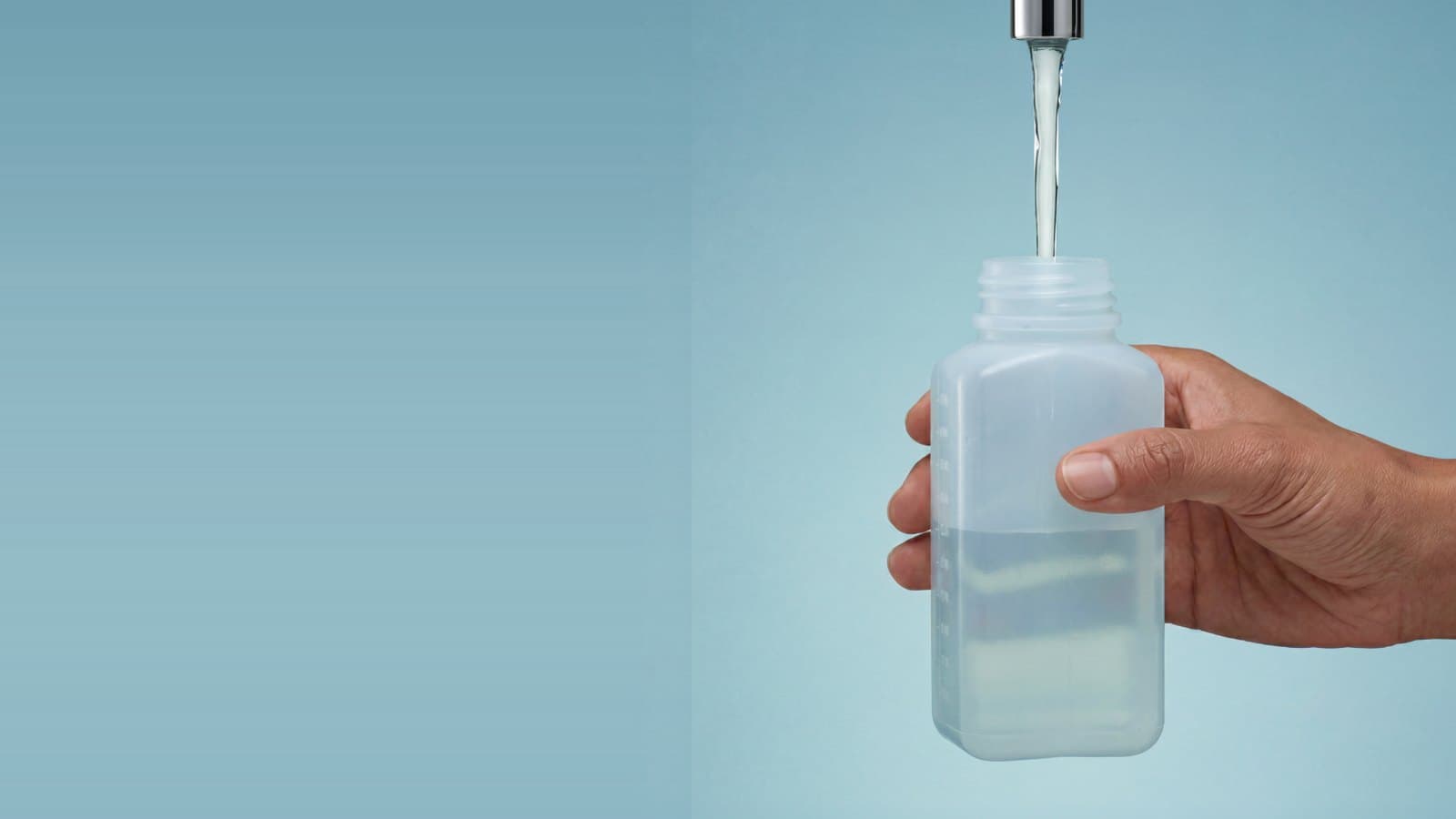
Start with the one you can measure and act on. If you're on a private well, live near an airport, military base, or manufacturing site, or just want to know, a water test tells you whether PFAS are in your tap water and at what levels. If PFAS shows up, the right filter can reduce them21. Test first, then pick the fix.
- 1.O’Hagan, D. Understanding organofluorine chemistry. An introduction to the C-F bond. Chem. Soc. Rev. 37, 308–319 (2008).
- 2.Evich, M. G. et al. Per- and polyfluoroalkyl substances in the environment. Science 375, eabg9065 (2022).
- 3.Buck, R. C. et al. Perfluoroalkyl and polyfluoroalkyl substances in the environment: terminology, classification, and origins. Integr. Environ. Assess. Manag. 7, 513–541 (2011).
- 4.Li, Y. et al. Half-lives of PFOS, PFHxS and PFOA after end of exposure to contaminated drinking water. Occup. Environ. Med. 75, 46–51 (2018).
- 5.Calafat, A. M., Wong, L.-Y., Kuklenyik, Z., Reidy, J. A. & Needham, L. L. Polyfluoroalkyl chemicals in the U.S. population: data from the National Health and Nutrition Examination Survey (NHANES) 2003-2004 and comparisons with NHANES 1999-2000. Environ. Health Perspect. 115, 1596–1602 (2007).
- 6.Smalling, K. L. et al. Per- and polyfluoroalkyl substances (PFAS) in United States tapwater: Comparison of underserved private-well and public-supply exposures and associated health implications. Environ. Int. 178, 108033 (2023).
- 7.Glüge, J. et al. An overview of the uses of per- and polyfluoroalkyl substances (PFAS). Environ. Sci. Process. Impacts 22, 2345–2373 (2020).
- 8.Schaider, L. A. et al. Fluorinated compounds in U.s. fast food packaging. Environ. Sci. Technol. Lett. 4, 105–111 (2017).
- 9.Hu, X. C. et al. Detection of poly- and perfluoroalkyl substances (PFASs) in U.s. drinking water linked to industrial sites, military fire training areas, and wastewater treatment plants. Environ. Sci. Technol. Lett. 3, 344–350 (2016).
- 10.Sunderland, E. M. et al. A review of the pathways of human exposure to poly- and perfluoroalkyl substances (PFASs) and present understanding of health effects. J. Expo. Sci. Environ. Epidemiol. 29, 131–147 (2019).
- 11.Hartmann, N. B. et al. Are we speaking the same language? Recommendations for a definition and categorization framework for plastic debris. Environ. Sci. Technol. 53, 1039–1047 (2019).
- 12.Wiesinger, H., Wang, Z. & Hellweg, S. Deep dive into plastic monomers, additives, and processing aids. Environ. Sci. Technol. 55, 9339–9351 (2021).
- 13.Thompson, R. C. et al. Twenty years of microplastic pollution research-what have we learned? Science 386, eadl2746 (2024).
- 14.Koelmans, A. A. et al. Microplastics in freshwaters and drinking water: Critical review and assessment of data quality. Water Res. 155, 410–422 (2019).
- 15.National Academies of Sciences, Engineering, and Medicine et al. Guidance on PFAS Exposure, Testing, and Clinical Follow-Up. (National Academies Press, Washington, D.C., DC, 2022). Link
- 16.Fenton, S. E. et al. Per- and polyfluoroalkyl substance toxicity and human health review: Current state of knowledge and strategies for informing future research. Environ. Toxicol. Chem. 40, 606–630 (2021).
- 17.Zahm, S. et al. Carcinogenicity of perfluorooctanoic acid and perfluorooctanesulfonic acid. Lancet Oncol. 25, 16–17 (2024).
- 18.Vethaak, A. D. & Legler, J. Microplastics and human health. Science 371, 672–674 (2021).
- 19.Marfella, R. et al. Microplastics and nanoplastics in atheromas and cardiovascular events. N. Engl. J. Med. 390, 900–910 (2024).
- 20.Dietary and inhalation exposure to nano- and microplastic particles and potential implications for human health. (2022). Link
- 21.Herkert, N. J. et al. Assessing the effectiveness of point-of-use residential drinking water filters for perfluoroalkyl substances (PFASs). Environ. Sci. Technol. Lett. 7, 178–184 (2020).
Nestwell screens your home environment. Results describe your water, air, or dust and are not a medical diagnosis.
Frequently asked questions
- Are PFAS and microplastics the same thing?
- No. PFAS are a family of synthetic chemicals that can dissolve in water or sit inside products and food. Microplastics are physical particles of plastic smaller than 5 millimeters. Because one is a chemical and the other is a particle, they need different tests.
- Will a PFAS water test tell me about microplastics?
- No. A test built to measure PFAS in your tap water won't tell you anything about microplastics, and the reverse is true too.
- Which should I test for first?
- Start with the one you can measure and act on. For most homes that's PFAS in drinking water, especially if you're on a private well or live near an airport, military base, or manufacturing site. If PFAS shows up, the right filter can reduce them.